In this guide
Quick answer: your card is worth what copies of the same print, in the same condition, recently sold for. Asking prices don't count. Five steps get you there:
- Match the name, set and collector number (like 3/82).
- Confirm the finish: holo, reverse holo, 1st Edition, Shadowless or Unlimited.
- Read the TCGplayer Market Price and recent eBay sold listings.
- Adjust for your card's real condition.
- Only then decide if grading is worth the fee and the wait.
Step 1: Find the exact print
Price guides don't price a Pokémon. They price one printing of one card. Before you look anything up, read three things off the card: the name, the set symbol and the collector number.
Dark Blastoise shows why. The Team Rocket set (2000) has two of them: 3/82 is the holo rare and 20/82 is the non-holo rare. The holo came back later in Legendary Collection as 4/110. Same name, three listings, three prices.
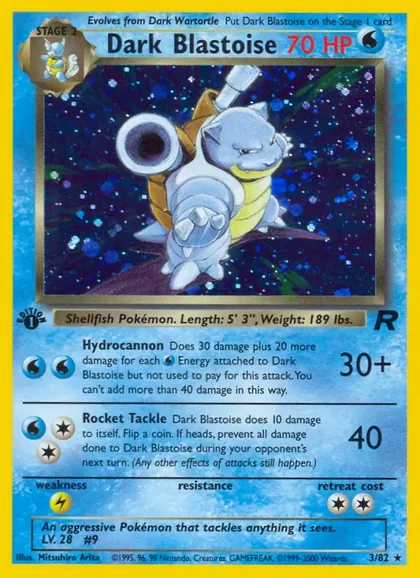 Dark BlastoiseTeam Rocket · 3/82 · holo rare
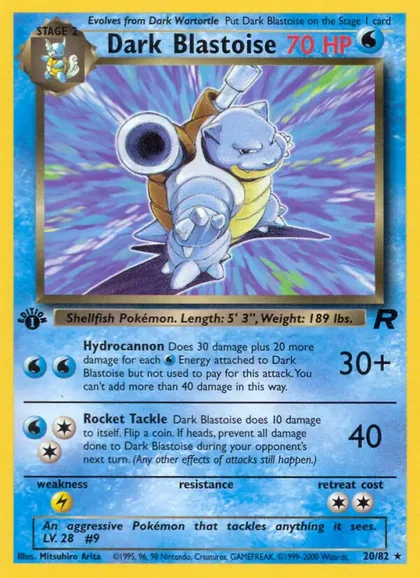 Dark BlastoiseTeam Rocket · 20/82 · non-holo rare
TCGplayer explains the number format: the first part is the card's number, the second is the set size printed on the card. A card numbered above the set size is a secret rare. Team Rocket introduced them, and newer sets still use them.
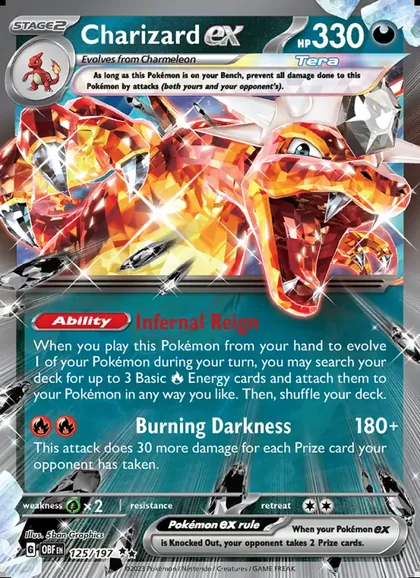 Charizard exObsidian Flames · 125/197
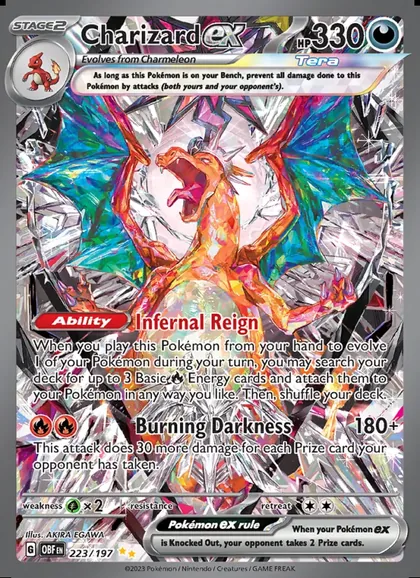 Charizard exObsidian Flames · 223/197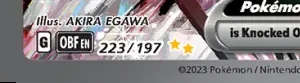
The set symbol is the small icon that names the expansion. Base Set cards have none, which is a clue in itself. If the symbol next to the number puzzles you, our Pokémon card rarity symbols chart covers each one.
Same number, different card. Base Set Charizard is 4/102. Its holo reprint in the Celebrations Classic Collection is also 4/102, but it carries a "Pokémon 25th Anniversary" stamp. Check stamps, not just the number.
Step 2: Check the finish and edition
One card number can come in several versions, and each has its own price. Tilt the card under a lamp to see where the shine sits. Then look under the artwork for a stamp.
| Version | How to spot it | What it means for the price |
|---|---|---|
| Holo (Rare Holo) | Foil shine on the artwork, black star rarity symbol. | In older sets, rarer than the non-holo Rare. In many English sets the non-holo twin has its own number. |
| Reverse holo | Foil on everything except the artwork. Same number and rarity as the regular card. First seen in Legendary Collection (2002). | TCGplayer: every pack has one, so they are not usually worth much more than the regular version. |
| 1st Edition | "EDITION 1" stamp in a black circle, under the art on the left. | Typically worth more than Unlimited. English 1st Edition runs exist only from Base Set through Neo Destiny, with none for Base Set 2. |
| Shadowless | Base Set only. No stamp, no drop shadow around the art window, thinner HP and attack text. | Highly sought after. High-grade Shadowless holos often sell far above their Unlimited versions. |
| Unlimited | No stamp. On Base Set, a drop shadow around the art window and bolder text. | The standard later print, priced as its own version. |
| Promo | A black star with the word "PROMO" instead of a rarity symbol. | Look it up under the matching Black Star Promos set. |
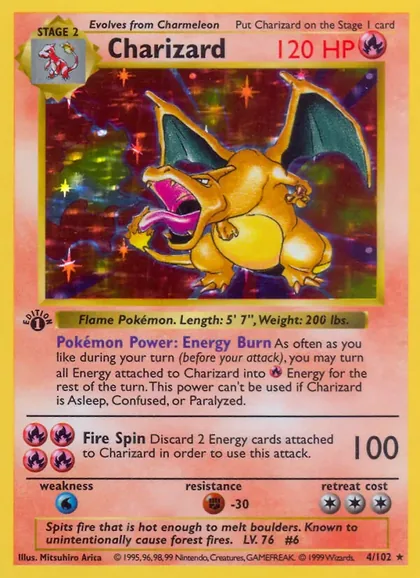 CharizardBase Set · 4/102 · 1st Edition holo
Two more details. Since Scarlet & Violet, every Rare pulled from a booster pack is holo; non-holo Rares now come from products such as theme decks. And Cardmarket says mixing up holo (a rarity) with reverse holo (a finish) is the most common mistake its sellers make. Shadowless Trainer and Energy cards have no art window, so check the copyright line instead: "© 1995, 96, 98, 99 Nintendo" on Shadowless, without the 99 on Unlimited.
Step 3: Look up what it actually sold for
Use sold prices, not asking prices. Anyone can list a card at any price. The useful number is what a buyer paid.
| Where | What the number is | Best for |
|---|---|---|
| TCGplayer Market Price | Built from recent completed sales on TCGplayer, averaged across several transactions | Raw English cards, US dollars |
| eBay sold listings | Individual completed sales, with photos | Rare cards with few TCGplayer sales |
| Cardmarket | Its own price trend, in euros | Buying or selling in Europe |
| PriceCharting, PSA Auction Prices Realized | Ungraded and graded sale prices | Graded (slabbed) cards |
How to check a Pokémon card's value on TCGplayer
- Find the right product Search the card name, then open the result whose set and number match your card.
- Set the filters Pick the printing that matches your card and your card's condition. TCGplayer says its price points follow these filters.
- Read the Market Price TCGplayer compiles it from recent completed sales on its site and updates it as transactions complete.
- Ignore the Listed Median It comes from listings only. In TCGplayer's own example, a card's Listed Median was almost double its Market Price, because copies listed near market kept selling.
- Check the volatility label "Indeterminate" means too few sales in 30 days to judge. Treat that price as a rough guess.
eBay sold listings
Search the card name, number and set, then filter to sold or completed listings. eBay's own pricing advice for sellers points to completed listings to see what items like yours went for. Skip active listings: those are asking prices. Trust a sale only if its photos show the same finish and similar wear.
Cardmarket for Europe
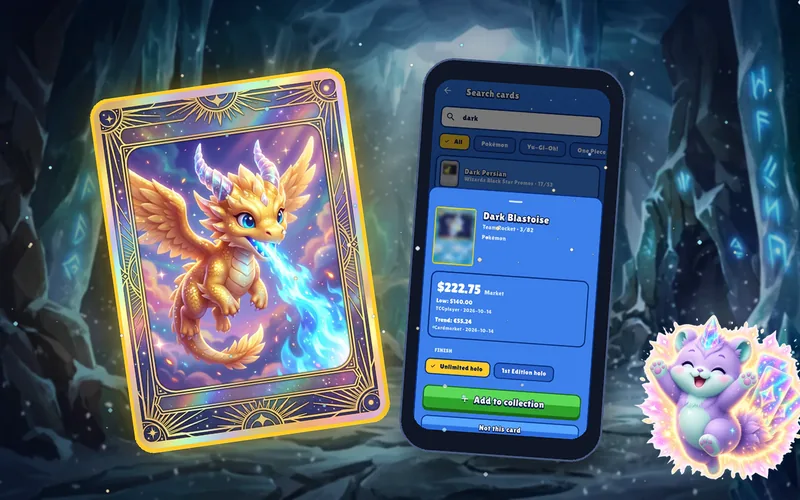
Cardmarket prices in euros and shows its own trend figure for each card. It is a separate market, so don't expect it to match TCGplayer. In the screenshot below, dated 2026-10-14, Dark Blastoise 3/82 shows $222.75 on TCGplayer and a €55.24 trend on Cardmarket. Use the market where you would actually sell.
Graded prices: PriceCharting and PSA
For slabbed cards, look at graded sales. PriceCharting keeps separate pages for Unlimited and 1st Edition Dark Blastoise and lists ungraded and graded prices side by side. PSA's Auction Prices Realized collects auction results for PSA-graded cards from eBay, Goldin and other platforms, updated daily. Never apply a PSA 10 price to a raw card.
The shortcut: a Pokémon card value app
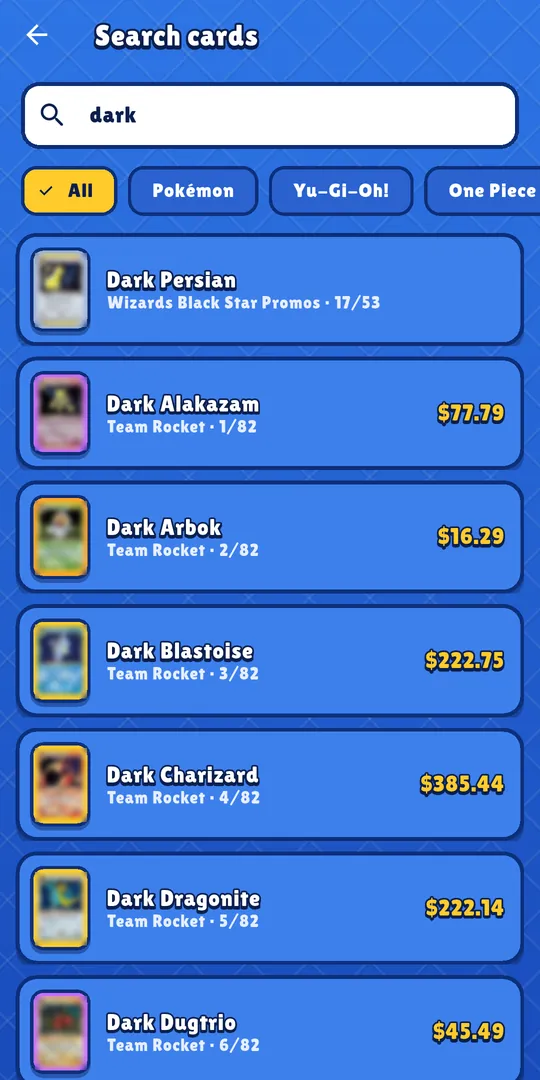
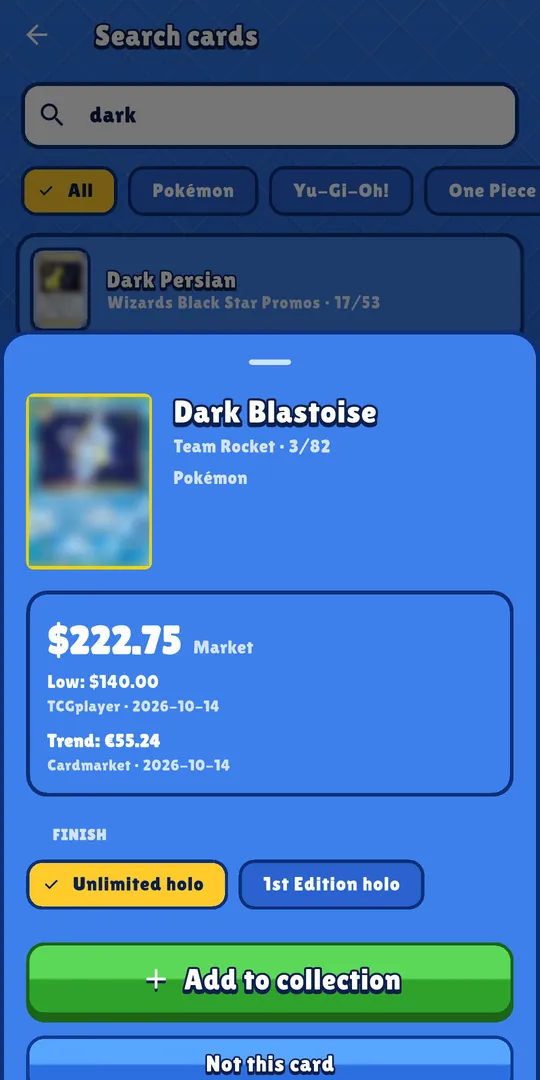
A Pullwise card scanner scan covers steps 1 to 3 in one go. It reads the printed number, finds the exact print, then shows the TCGplayer market and low prices in dollars and the Cardmarket trend in euros, each with its date. The finish picker switches between versions such as Unlimited holo and 1st Edition holo. If a print or finish has no price, the app says so.
It does not grade cards or judge condition, so step 4 is still yours. You get 5 free scans a day; search by name or number is free and unlimited. For camera tips, read how to scan Pokémon cards for their value. To weigh the options, see our card scanner apps compared.
Step 4: Adjust for condition
Two copies of the same print can sell far apart because of wear. TCGplayer sorts raw cards into five conditions, and its prices change with the condition filter. Near Mint is the top of its scale: TCGplayer doesn't sell Mint or Gem Mint cards.
| Condition | What it looks like (TCGplayer's standard, shortened) |
|---|---|
| Near Mint (NM) | Minimal wear. Nearly unmarked surface, crisp corners. Slight edge wear or a couple of minor scratches at most. |
| Lightly Played (LP) | Minor edge wear, scuffs or scratches. No major flaws or structural problems. |
| Moderately Played (MP) | Edge and surface wear, scratching, even bends with creases, as long as the card's structure is intact. |
| Heavily Played (HP) | A major amount of wear: creasing, whitening and other faults. Still authentic and not structurally damaged. |
| Damaged (DMG) | Tears, splitting, major bends, liquid or other damage that affects the card's integrity. Altered cards (ink, signatures) count too. |
Cardmarket uses a different seven-step ladder: Mint, Near Mint, Excellent, Good, Light Played, Played and Poor. The same two letters don't mean the same step on both sites, so compare like with like.
Tip: Check under a bright lamp. Look at all four corners, then every edge on the front and back, then tilt the card to catch scratches on the surface. Be stricter than feels fair: the buyer will be.
Step 5: Is your Pokémon card worth grading?
PSA authenticates a card, grades it from 1 to 10 and seals it in a tamper-evident case. CGC and Beckett also grade Pokémon cards. A high grade can lift the price; whether it pays for your card is arithmetic.
The top grades are strict. PSA describes a Gem Mint 10 as a virtually perfect card: four perfectly sharp corners, sharp focus, full original gloss and no staining. The centering must be within about 55/45 on the front and 75/25 on the back. CGC goes one step further with Pristine 10, a card that is flawless under 10x magnification.
Grading also costs money and time. When we checked PSA's pricing page on 2026-10-18, its cheaper Value tiers were paused. The Standard tier was $59.99 per card, for cards with a max insured value of $1,000, with an estimated 90 to 100 business days. PSA says turnaround times are estimates, not guarantees.
- Start from the raw price Use the price for your card's real condition from step 4.
- Find graded sales at a realistic grade Look up recent sales at the grade your card could actually get, not just PSA 10.
- Subtract the costs Take off the grading fee and shipping the card both ways.
- Count the wait Your card is gone for months, and the market can move meanwhile.
- Decide If what's left is small, sell or keep the card raw.
Grading starts with authentication. PSA won't give a numeric grade to cards that show trimming, recoloring or restoration, and a card of questionable authenticity gets no grade while the fee still applies.
Red flags that a price is wrong
- It's an asking price. Active listings and TCGplayer's Listed Median show what sellers hope for, not what buyers paid.
- It rests on one sale. A single "Most Recent Sale" or an "Indeterminate" volatility label means thin data.
- It's the wrong print. Right name, wrong set or number. Watch for reprints: TCGplayer notes that some deck-exclusive and league promo cards reuse the original set symbol and collector number with a different rarity.
- It's the wrong finish. A reverse holo priced as a holo, or an Unlimited card priced as 1st Edition.
- It's the wrong language. Japanese cards are separate products on TCGplayer and Cardmarket, and Japanese sets don't line up 1:1 with English ones.
- It's a graded price. A PSA 10 sale says nothing about a raw card from a binder.
- It mixes markets. Dollars from TCGplayer and euros from Cardmarket are different markets, as the example above shows.
- The card itself is fake. Cardmarket's counterfeit guide lists the tells: "Pokemon" without the accent, a "2nd Edition" label (no such print exists), very thick borders, wrong fonts, glossy card stock and washed-out colors.
Is my Pokémon card worth anything? Old cards to check first
If you have a box of old cards, price these first:
- Base Set 1st Edition and Shadowless holos. Bulbapedia calls Base Set's 1st Edition cards the most valuable 1st Edition run, and Shadowless holos in high grade often sell well above Unlimited ones. Base Set's English release was January 9, 1999.
- Any 1st Edition card from Base Set to Neo Destiny. The stamp typically adds value, though the last runs carry less of a premium.
- Holo rares from older sets. In older expansions, holo rares were not guaranteed in packs and were rarer than non-holo rares.
- Secret rares. Any card numbered above its set size.
- Error cards. Some 1st Edition runs had mistakes that were fixed in Unlimited, and collectors look for them.
Age alone doesn't set a price. Cardmarket holds a 20-year-old card to the same condition standard as a new one, so a worn 1999 card sells as a worn card. Not sure where to start? Run the box through Pullwise's free card search by name or number, then spend your time on the cards with a real price.
Sources
- TCGplayer Help — TCGplayer Market Price (Market Price is based on actual recent sales, averaged across multiple recent transactions, not on listed prices)
- TCGplayer Help — What do the different price points on TCGplayer.com mean? (Market Price from recent completed sales; Listed Median from listings only, with its example; 30-day volatility; price points follow printing and condition filters)
- TCGplayer Help — Card Conditioning Overview (the five conditions and what each allows; Mint and Gem Mint not sold on TCGplayer; altered cards count as Damaged)
- TCGplayer Help — What are the rarities of Pokémon TCG cards? (number format; holo rares and their non-holo twins; reverse holo and its value; secret rares; PROMO star; promo reprints)
- TCGplayer Help — Listing Japanese Pokémon Products FAQ (separate Pokemon Japan product line; Japanese and English sets are not a 1:1 match)
- eBay — How to price your items (check completed listings to see what items like yours sold for)
- Cardmarket Help — Finding and Listing Pokémon Cards (the 1st Edition stamp; Japanese cards on separate pages; holo vs reverse holo; reverse holos since Legendary Collection, 2002)
- Cardmarket Help — Card Condition (the seven-step condition scale; no allowance for a card's age)
- Cardmarket Help — Spotting a Counterfeit (missing accent, "2nd Edition", thick borders, fonts, glossy stock and color as signs of a fake)
- PriceCharting — Dark Blastoise #3 Prices and Dark Blastoise [1st Edition] #3 (separate pages per edition with ungraded and graded prices)
- PSA — Auction Prices Realized (auction results for PSA-graded cards from eBay, Goldin and more, updated daily)
- PSA — Grading Standards (Gem Mint 10 requirements; no numeric grade for trimmed, recolored, restored, cleaned or pressed cards)
- PSA — Trading Card Grading pricing (checked 2026-10-18: Value tiers paused; Standard $59.99 per card, max insured value $1,000, estimated 90 to 100 business days; estimates not guaranteed)
- CGC Cards — Grading Scale (Pristine 10 above Gem Mint 10, flawless under 10x magnification)
- Bulbapedia — 1st Edition (TCG) (1st Edition runs from Base Set to Neo Destiny, not Base Set 2; value versus Unlimited; error cards; Shadowless)
- Bulbapedia — Dark Blastoise (Team Rocket 3) (3/82 Rare Holo, 20/82 Rare, Legendary Collection 4/110 reprint)
- Bulbapedia — Team Rocket (TCG) (English release April 24, 2000; introduced secret cards)
- Bulbapedia — Base Set (TCG) (English release January 9, 1999; no set symbol; Charizard 4/102 Celebrations reprint with the 25th Anniversary stamp)
- Bulbapedia — Holofoil and Rarity (TCG) (holo rares not guaranteed and rarer than non-holo rares in older sets; booster Rares always holo since Scarlet & Violet)