In this guide
- Where the rarity symbol is on a Pokémon card
- Pokémon card rarity chart
- How to tell if a Pokémon card is a secret rare
- Holo, reverse holo and non-holo: a finish, not a rarity
- Older rarity symbols: Sword & Shield and earlier
- Promo cards: the black star with PROMO
- Vintage Base Set: 1st Edition and Shadowless
- Check the exact print and price
Look right after the collector number at the bottom of the card. That symbol is the rarity:
- ● Common · ◆ Uncommon · ★ Rare
- ★★ Double Rare · ★★ Ultra Rare
- ★ Illustration Rare · ★★ Special Illustration Rare · ★★★ Hyper Rare
- A number above the set total, like
244/198, means a secret rare.
Where the rarity symbol is on a Pokémon card
On cards printed since Scarlet & Violet (March 2023), everything you need sits in one short row in the bottom left corner. Sun & Moon and Sword & Shield cards use the bottom left too, with a small set symbol in place of the set code. Older cards, from Base Set through the XY era, put the number and the symbol in the bottom right corner.
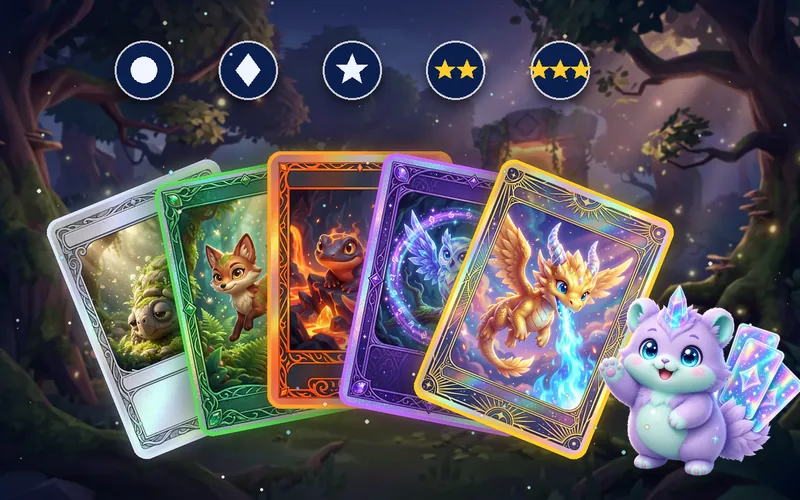
The diagram uses one of Pullwise's own fantasy cards, not a real Pokémon card. The labels copy the row on a real Scarlet & Violet card, which you can see in the close-ups further down.
 1
G SVI EN
025/198 ●
2
3
4
1
G SVI EN
025/198 ●
2
3
4
- Card name. It tells you which Pokémon, not which print. Miraidon ex appears four times in the Scarlet & Violet base set alone, at four different rarities.
- Regulation mark and set code. The boxed letter (G here) decides tournament legality, not rarity. English cards have carried it since Sword & Shield. Next to it, a three-letter code plus the language, like SVI EN, names the set. That code replaced the little set-symbol picture with Scarlet & Violet.
- Collector number.
025/198is card 25 of the 198 in the set's printed list. - Rarity symbol. Right after the number. Shape, color and count all matter.
Pokémon card rarity chart
This chart covers English cards from the Scarlet & Violet series (from March 31, 2023) and the Mega Evolution series that followed it (from September 26, 2025). The first eight rows run roughly from least to most rare, in the order TCGplayer uses. The rest are special rarities that appear only in some sets.
| Symbol | Rarity name | Era | What the card looks like |
|---|---|---|---|
| ● | Common | Every era | Regular card. Also comes as a reverse holo. |
| ◆ | Uncommon | Every era | Regular card. Also comes as a reverse holo. |
| ★ | Rare | Every era | Since Scarlet & Violet, every Rare in a booster pack has foil art. |
| ★★ | Double Rare | Scarlet & Violet, Mega Evolution | Regular-art Pokémon ex, foil. Numbered inside the set total. |
| ★★ | Ultra Rare | Scarlet & Violet, Mega Evolution | Full-art Pokémon ex or Supporter. From Mega Evolution, also full-art Items, Tools and Stadiums. |
| ★ | Illustration Rare | Scarlet & Violet, Mega Evolution | Full-art alternate art of a regular Pokémon, not an ex. |
| ★★ | Special Illustration Rare | Scarlet & Violet, Mega Evolution | Full-art alternate art of a Pokémon ex or a Supporter. |
| ★★★ | Hyper Rare | Scarlet & Violet | Gold card: gold border and gold background. |
| ✦ | Mega Hyper Rare | Mega Evolution | Gold-etched Mega Evolution Pokémon ex on a gold background. |
| ★★ | Mega Attack Rare | Mega Evolution | Pop-art Mega Evolution Pokémon ex with the attack name in huge letters. The stars are one pink, one green. |
| ★ | ACE SPEC Rare | Scarlet & Violet, from Temporal Forces | Magenta-design Trainer or Special Energy. Only one ACE SPEC is allowed per deck. |
| ☆ | Shiny Rare | Paldean Fates (2024) | Shiny Pokémon, numbered past the set total (092/091 onward). |
| ☆☆ | Shiny Ultra Rare | Paldean Fates (2024) | Shiny full-art Pokémon ex. |
| ★☆ | Black White Rare | Black Bolt and White Flare (2025) | Full art printed almost entirely in black and white, such as Zekrom ex 172/086. |
Sources disagree on one color: Bulbapedia and CGC call the Ultra Rare stars silver, TCGplayer calls them white, and the Pokémon Company says "two shiny foil stars". On the card they look pale and foiled, as the close-up of Miraidon ex 227/198 below shows. Either way, they aren't the solid black of a Double Rare or the gold of a Special Illustration Rare.
Here are the first three tiers on real cards from the Scarlet & Violet base set. Under each card is a close-up of its number and rarity symbol.
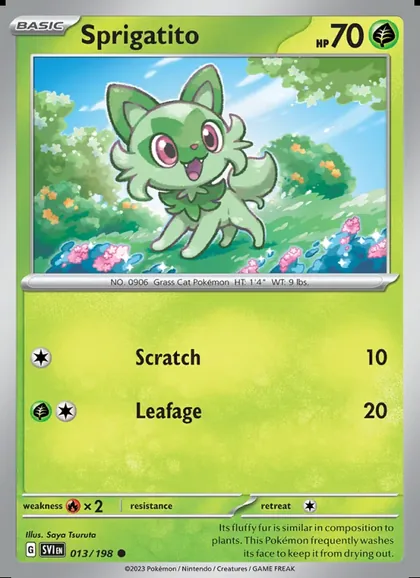
 Sprigatito013/198 · Common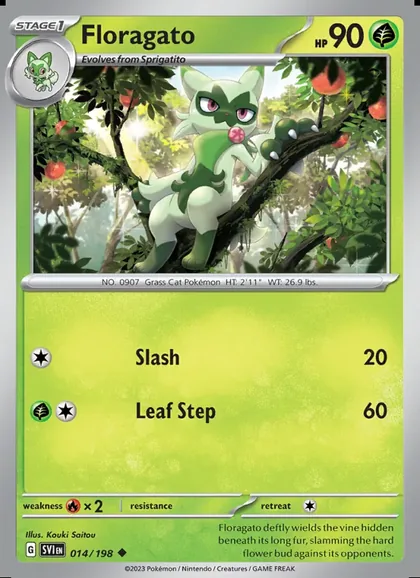
 Floragato014/198 · Uncommon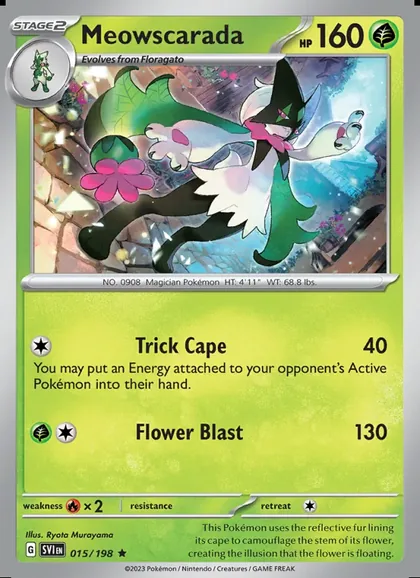
 Meowscarada015/198 · Rare
A rarity symbol tells you how often a card was printed compared with other cards in its set, not what it's worth. TCGplayer's own example: an old Common Pikachu can sell for more than a new Ultra Rare.
How to tell if a Pokémon card is a secret rare
Check the collector number. If the first number is bigger than the second, the card is a secret rare: 244/198 in the Scarlet & Violet base set, or the vintage Shining Charizard at 107/105. "Secret rare" isn't one of the official rarity names. It's what collectors call any card numbered past the set's printed total.
In Scarlet & Violet sets, all the full-art cards are secret. The base set prints 198 as its total but has 258 cards. Cards 199 to 258 are all secret, in this order:
- 199–222: Illustration Rares
- 223–242: Ultra Rares
- 243–252: Special Illustration Rares
- 253–258: Hyper Rares
Mega Evolution works the same way. Its first set prints 132 as the total and ends with two Mega Hyper Rares at 187/132 and 188/132.
The same Pokémon ex can sit on both sides of the line. Miraidon ex appears three times below: once inside the set list, twice above it.
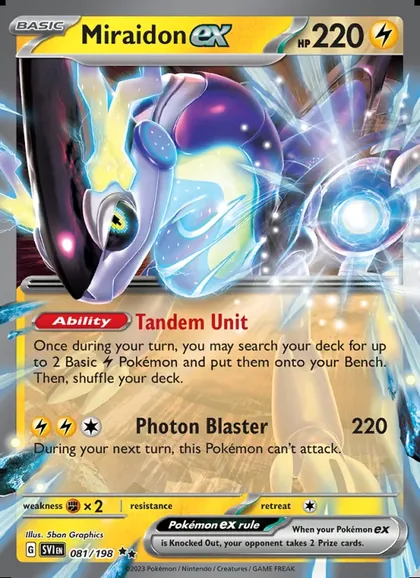
 Miraidon ex081/198 · Double Rare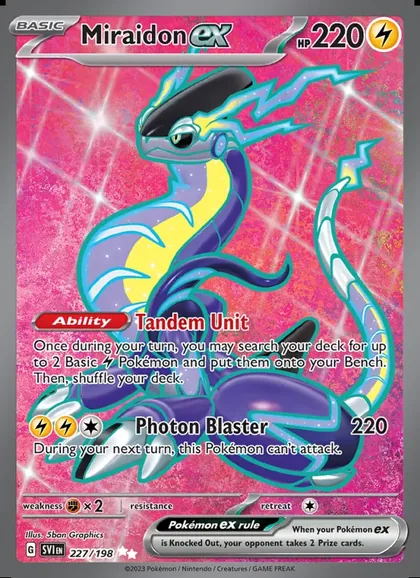
 Miraidon ex227/198 · Ultra Rare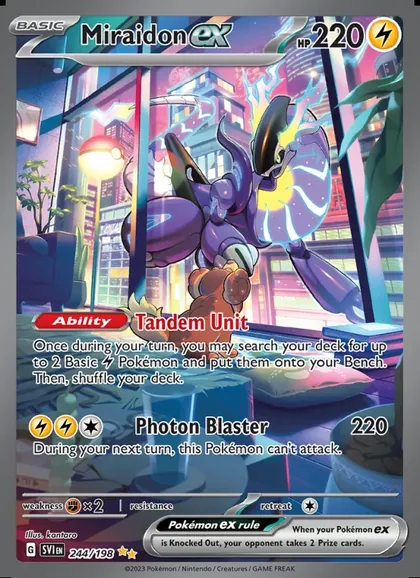
 Miraidon ex244/198 · Special Illustration Rare
How to tell if a Pokémon card is an SIR
A Special Illustration Rare passes three checks:
- Two gold stars. They sit right after the number. One gold star is an Illustration Rare; three is a Hyper Rare.
- A number above the set total. For example 244/198.
- New full-card art of a Pokémon ex or a Supporter. Compare Miraidon ex 244 with 227: same attacks, a whole new scene.
The two gold neighbors are easy to tell apart. An Illustration Rare has one gold star and shows a regular Pokémon, not an ex. A Hyper Rare has three gold stars and a gold card.
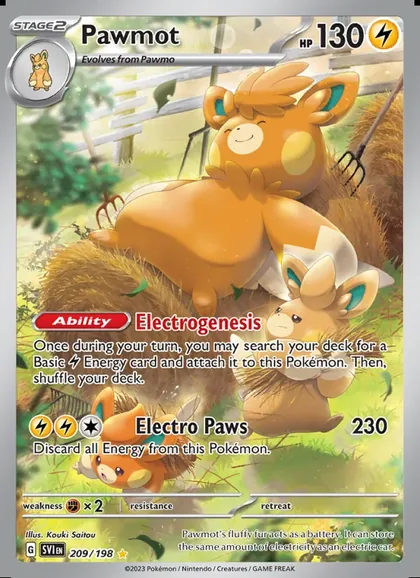
 Pawmot209/198 · Illustration Rare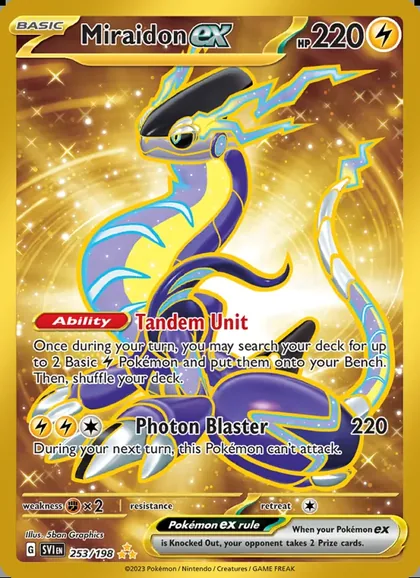
 Miraidon ex253/198 · Hyper Rare
Numbers with letters
Some subsets number their cards with letters. Sword & Shield's Trainer Gallery, from Brilliant Stars on, runs TG01/TG30 and up: full-art cards of a Pokémon with a Trainer. Keep the letters when you look the card up.
Holo, reverse holo and non-holo: a finish, not a rarity
Foil is the finish of a card, not its rarity. There are three basic finishes:
- Non-holo: no foil anywhere.
- Holo: the picture itself is foil.
- Reverse holo (the official name is Parallel Foil): everything is foil except the picture.
A reverse holo Sprigatito is still a Common, and it still has a circle. Because reverse holos exist at the lower rarities, TCGplayer notes that you can't tell a card's rarity from the foil alone.
Since Legendary Collection, English booster packs have held at least one reverse holo. With Scarlet & Violet, every Rare in a pack became holo, and packs went from two guaranteed foil cards to three. Some sets add their own foils: Black Bolt and White Flare added reverse holos with a Poké Ball or Master Ball pattern, and Mega Evolution brought back Mirror Holofoil.
The finish changes the price, even when the rarity doesn't. Our guide on how to check a Pokémon card's value shows how to match the finish before you read a price.
Older rarity symbols: Sword & Shield and earlier
Before March 2023 the ladder was shorter, and one star did a lot of work. Use this table for cards printed before Scarlet & Violet.
| Symbol | Rarity name | Era | What the card looks like |
|---|---|---|---|
| ★ | Rare or Holo Rare | 1999 to January 2023 | No foil: Rare. Foil only in the picture: Holo Rare, also called Rare Holo. |
| ★ | Rare, Holo Rare, Ultra Rare and others | Before 2023 | The same white star also marked Rare Holo EX, Rare Holo GX, Rare Holo LV.X, Rare Prime and Rare BREAK. The card's name and style tell them apart. |
| ★ | LEGEND or Rare Holo Star | Before 2023 | On older cards a single gold star means one of these, not an Illustration Rare. |
| A | Amazing Rare | Sword & Shield | A rainbow "A" symbol. The multicolor swirl behind the Pokémon spills out of the picture frame. |
| TG | Trainer Gallery | Sword & Shield, from Brilliant Stars | Full art of a Pokémon with a Trainer, numbered like TG01/TG30. |
| 101/100 | Rainbow Rare, Gold Rare (secret rares) | Sun & Moon, Sword & Shield | Full art in rainbow foil, or with a gold border and frame. Gold cards from Scarlet & Violet on are Hyper Rares instead. |
Sword & Shield's big Pokémon have their own rarity names in the card databases: Holo Rare V, Holo Rare VMAX and Holo Rare VSTAR. A Pokémon V such as Zacian V (138/202) also carries a white star, so the quickest tell is the name on the card itself. Radiant Rares, from Astral Radiance on, show a Shiny Pokémon with a special foil, and a deck can hold only one.
Holo Rare ended with Sword & Shield. On a card from Scarlet & Violet on, a single black star simply means Rare, and Rares from booster packs are holo.
Promo cards: the black star with PROMO
A black star with the word PROMO across it means a promo card. Promos aren't pulled from regular booster packs. They come from events, tins, boxes and other products, and how scarce they are depends on how they were handed out.
Not every promo carries that star. Some promos are reprints of set cards and keep their original rarity symbol. A stamp or a different foil pattern usually marks them. Mega Attack Rares are a special case: Bulbapedia notes that until Ascended Heroes put them in an expansion, English Mega Attack Rare cards came out only as MEP Black Star Promos.
Vintage Base Set: 1st Edition and Shadowless
For 1999 cards, the print run can matter as much as the rarity. These are not rarities: a 1st Edition Charizard is still a holo Rare with a black star.
- Look for the stamp. A 1st Edition card has a small round "Edition 1" stamp near the lower left corner of the picture frame. English 1st Edition runs went from Base Set to Neo Destiny, skipping Base Set 2.
- No stamp? Check the right edge of the picture frame. Unlimited cards have a drop shadow along it. Shadowless cards don't. Shadowless exists only in the 1999 Base Set.
- Check the HP. 1st Edition and Shadowless Base Set cards use a thinner HP font. Unlimited cards print it thicker.
PSA notes that collectors usually want 1st Edition most, then Shadowless, then Unlimited. Before you price one, see what your Pokémon card is worth for the condition and grading side.
Check the exact print and price
The rarity gets you halfway. To price a card you also need the exact print and finish. Pullwise's free card scanner reads the number at the bottom, like 025/198, finds that exact print and shows its price after a pack-opening reveal. A finish picker switches between normal, holo, reverse holo, 1st Edition and Unlimited, because each one has its own price.
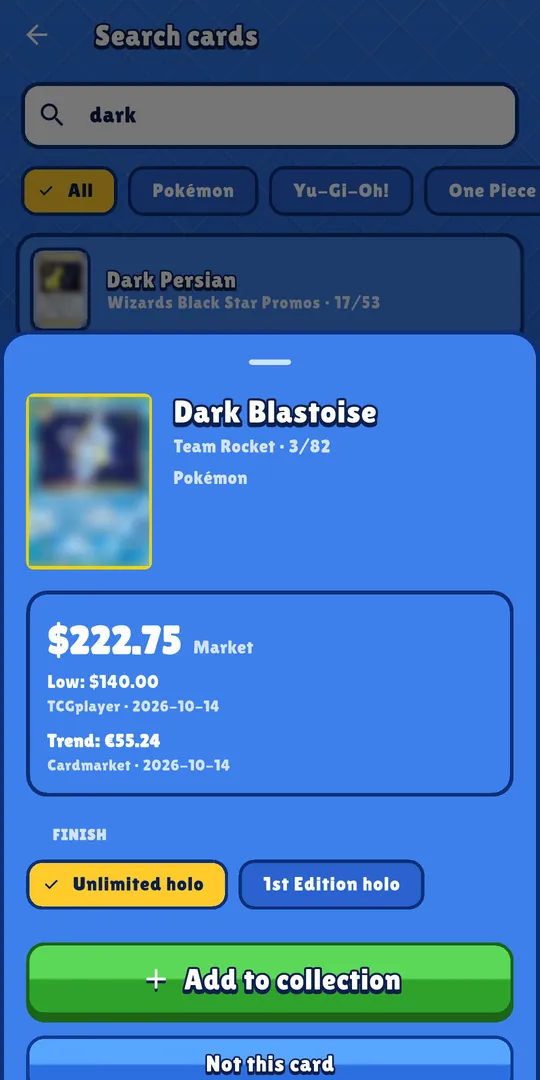
Prices come from TCGplayer (USD) and Cardmarket (EUR), each with its date, and the app says so when a finish has no price. You get 5 free scans a day plus unlimited free search by name or number. The photo is read on your phone and deleted, and there's no account. Pullwise covers English Pokémon prints, doesn't grade cards, and isn't affiliated with Nintendo or The Pokémon Company.
For sharper scans, see how to scan Pokémon cards for value. Collect Yu-Gi-Oh! too? Our Yu-Gi-Oh! rarity guide covers its foils and set codes.
Sources
- Bulbapedia — Rarity (every symbol in the chart, including the pink ACE SPEC star, hollow Shiny stars, Mega Hyper Rare and Mega Attack Rare; secret rare numbering; reverse holos since Legendary Collection; MEP promos; Japanese letter codes; read via the Internet Archive copy of 4 Oct 2026)
- Bulbapedia — Scarlet & Violet (TCG) (March 31, 2023; 198 printed, 258 cards; set codes replace set symbols; three foil cards per pack; rarity of each card shown)
- Bulbapedia — Special illustration rare, Hyper rare, Mega hyper rare and Black White rare pages (what each tier shows and its symbol)
- Bulbapedia — Mega Evolution (TCG) (September 26, 2025; 132 printed, 188 cards; full-art Items, Tools and Stadiums; Mirror Holofoil)
- Bulbapedia — Paldean Fates, Black Bolt and Brilliant Stars (Shiny Rares from 092/091; Poké Ball and Master Ball foils; Trainer Gallery TG01/TG30)
- Bulbapedia — 1st Edition (TCG) and Regulation mark (1st Edition runs through Neo Destiny; Shadowless; regulation marks since Sword & Shield)
- Pokémon.com — Scarlet & Violet Revamps Pokémon TCG Card Aesthetic (March 30, 2023: the new star symbols for Double, Ultra, Illustration and Hyper Rare)
- TCGplayer — How to Tell the Rarity of a Pokémon Card (updated Aug 6, 2025: rarity order, secret rares, pre-2023 white and gold stars, PROMO star, rainbow "A", Shiny stars, Parallel Foil, cards without symbols)
- CGC — Understanding Pokémon Rarity Symbols (updated March 26, 2026: silver Ultra Rare stars, gold stars, Mega Attack Rare colors)
- PSA — Pokémon Collecting Basics Guide (1st Edition stamp, Shadowless and Unlimited differences)
- TCGdex — card database (rarities and scans of the cards shown; secret number ranges; Holo Rare V, VMAX and VSTAR; number position on older cards; scans of Hero's Cape TEF 152, Zekrom ex BLK 172, Mega Diancie ex ASC 267 and Mega Gardevoir ex MEG 187 used to check the ACE SPEC, Black White, Mega Attack and Mega Hyper symbols, checked 2026-10-18)