In this guide
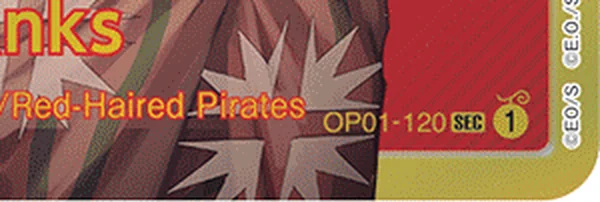
One Piece card rarity is the letter code in a small box at the bottom right, right after the card number (for example OP01-120 SEC). From lowest to highest: C Common, UC Uncommon, R Rare, SR Super Rare, SEC Secret Rare. L marks a Leader and P a promo.
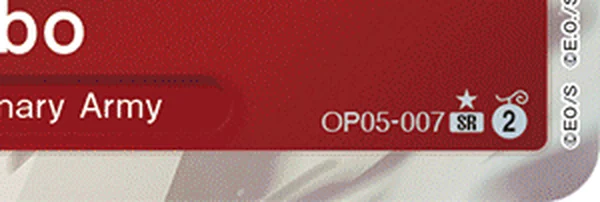
Chase versions are marked separately: a small ★ above the code means a parallel (alt art), and an SP or TR box in front of the card number means a Special card or a Treasure Rare.
Where the rarity code is printed
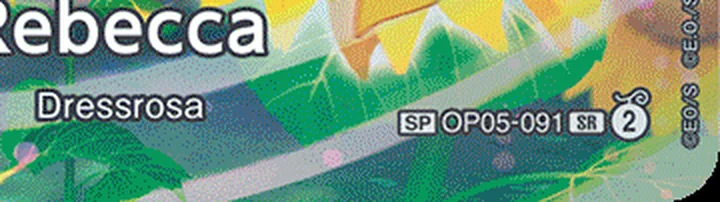
Look at the bottom right corner, just under the card's type line. Bandai's official rule manual labels three things there: the card number, the rarity and the block symbol. One Piece doesn't use shapes like the circle, diamond and star on Pokémon cards. It prints letters.
 SP
OP05-091
SR
★
1
2
3
4
SP
OP05-091
SR
★
1
2
3
4
- Card number. The prefix names the product line: OP is a booster pack, ST a starter deck, EB an extra booster, PRB a premium booster and P a promo. OP05-091 is card 091 of the fifth booster set.
- Rarity code. C, UC, R, SR, SEC, L or P in a small box. Parallels, SP cards and Treasure Rares keep the original card's code here.
- Parallel star. A small ★ above the rarity box marks a parallel on newer cards. Parallels from the first sets don't have it.
- SP or TR box. Printed in front of the card number (on some cards just above it) on Special cards and Treasure Rares only.
Right of the rarity box sits a number in a circle. That is the block number, which Bandai uses to group cards for tournament formats. The comprehensive rules say both the rarity and the block symbol have no effect on gameplay.
One Piece card rarity chart
Bandai's product page for the first booster, Romance Dawn [OP-01], lists 121 card types: 45 Commons, 30 Uncommons, 26 Rares, 10 Super Rares, 2 Secret Rares and 8 Leaders. That spread is the base ladder. The higher the tier, the fewer card types it has.
| Code | Name | What it means | How to spot it |
|---|---|---|---|
| C | Common | The largest tier: 45 types in OP-01. | C in the rarity box. |
| UC | Uncommon | 30 types in OP-01. | UC in the box. Same frame as a Common. |
| R | Rare | 26 types in OP-01. | R in the box. |
| SR | Super Rare | 10 types in OP-01. | SR in the box. |
| SEC | Secret Rare | The top base rarity: 2 types in OP-01. | SEC in the box. |
| L | Leader | Not a step on the ladder. Every player uses exactly 1 Leader. 8 types in OP-01. | LEADER above the name, a Life value, L in the box. |
| P | Promo | Cards from events and some products. | Card number starts with P-, P in the box. |
| SP | Special card | An existing card, usually an older one, in a new special design. First in OP-03. | SP box before the card number. |
| TR | Treasure Rare | One card type per booster set since OP-06. | TR box before the card number. |
| ★ | Parallel | Not a rarity. An alt-art version of a card at any rarity. | Star above the rarity box on newer cards. |
The chase versions sit outside this ladder: parallels (at any rarity), SP cards and the single Treasure Rare. Bandai's product pages list which of these a set contains, not how often you pull them, so this guide doesn't rank them against each other. The official pages do show scale. Awakening of the New Era [OP-05] lists 27+1 parallel designs, boosters since OP-03 carry between 4 and 12 SP versions in the card list, and each booster since OP-06 has exactly one TR.
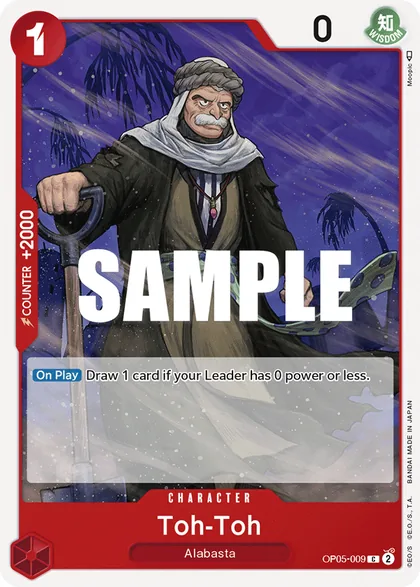 Toh-TohOP05-009 · C
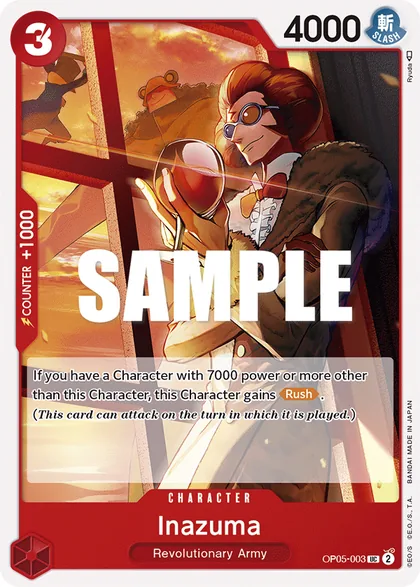 InazumaOP05-003 · UC
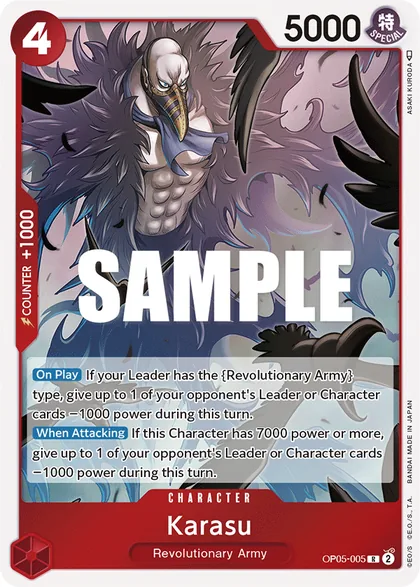 KarasuOP05-005 · R
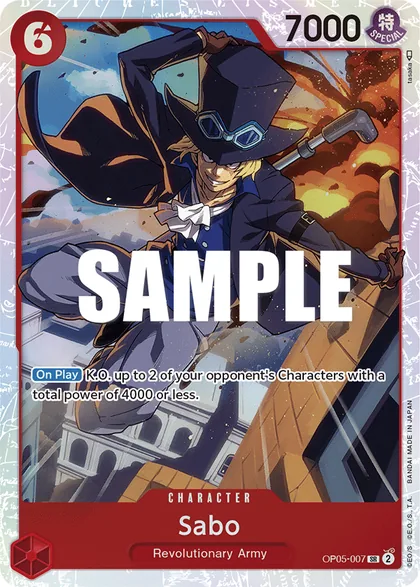 SaboOP05-007 · SR
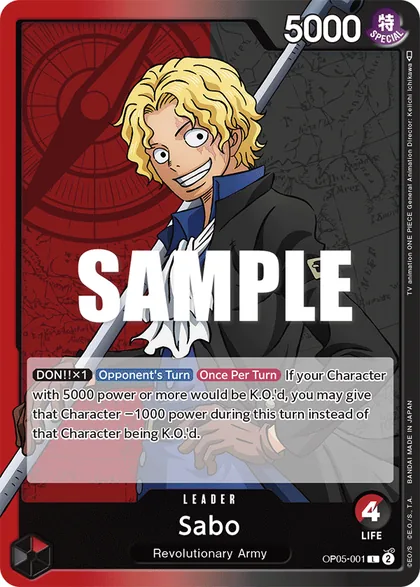 SaboOP05-001 · L (Leader)
Other games mark rarity in their own way: see the Pokémon card rarity symbols chart and the Yu-Gi-Oh! rarity guide.
Parallels, alt art and the star
A parallel is the same card with a different design. It keeps the card number, the rarity code and the text. Bandai's first booster page already promoted "parallel cards" with different illustrations. Newer pages call them Alt-Art cards and describe the treatments: art that covers the whole card, a shiny finish, or a textured surface.
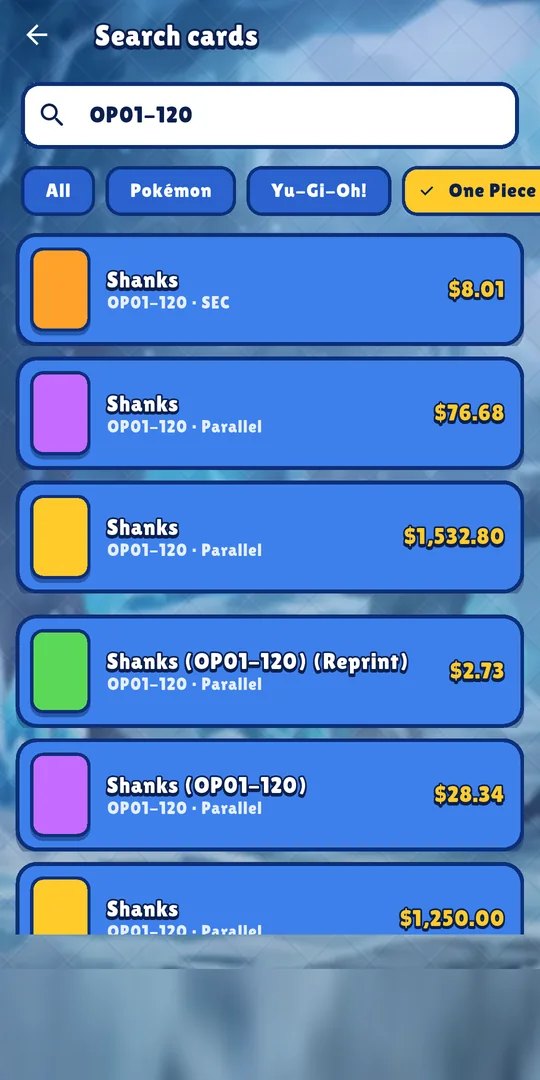
Bandai's card list gives every version its own entry. Search OP01-120 there and you get six: the regular Shanks and two parallels from Romance Dawn, plus three more from the premium booster ONE PIECE CARD THE BEST [PRB-01].
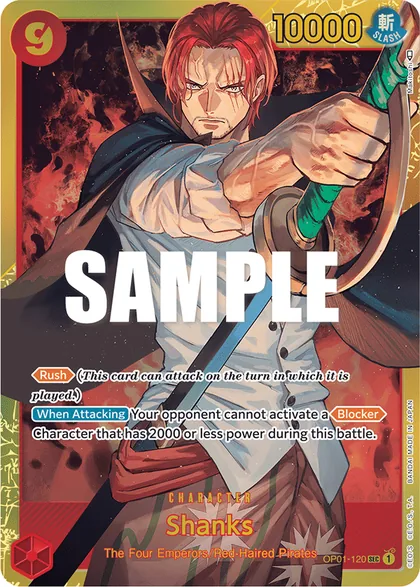 ShanksOP01-120 · SEC · regular
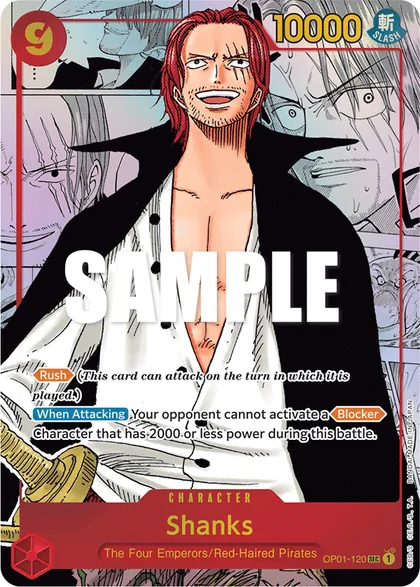 ShanksOP01-120 · SEC · parallel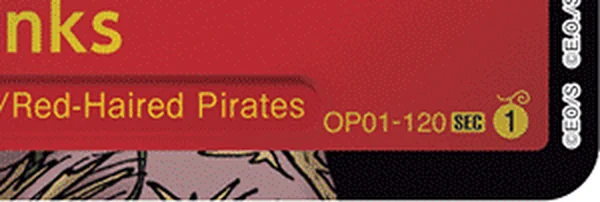
The star above the rarity box
In Bandai's card images, parallels from Kingdoms of Intrigue [OP-04] onward carry a small ★ above the rarity box. The OP-01 and OP-03 parallels we checked have none. So a star means parallel, but no star doesn't prove a regular print. Compare the art with the card list.
Super parallels and "manga rares"
"Manga rare" is collector slang, not a rarity. You won't find it printed on a card or in Bandai's card list. Bandai's own words for its most luxurious alt arts are "Super Parallel" on the OP-05 page and "Super Alt-Art" on newer pages. The OP-17 page describes a Super Alt-Art as an alt art with a luxurious design, shows one covered in designs from the ONE PIECE manga, and also introduces a Super Leader Alt-Art. TCGplayer tags manga versions in the product name, for example "Shanks (Parallel) (Manga) (Alternate Art)" from Romance Dawn, and still lists that one as a Secret Rare.
SP cards and Treasure Rares (TR)
Both are versions of a card that also has a regular print, so both keep its card number and rarity code. The extra letters sit in a box in front of, or just above, the card number.
SP cards first appeared in Pillars of Strength [OP-03], which lists 4 Special Cards. Each one brings back an older card with new art. Bandai's card list shows Monkey.D.Luffy ST01-012, a Super Rare from Starter Deck 1, returning as an SP card in OP-03. The card list writes the rarity as "SP CARD", while the printed box still says SR.
Treasure Rares start with Wings of the Captain [OP-06], released March 15, 2024, whose product page lists one Treasure Rare. Every booster from OP-06 to OP-17 has exactly one TR in the English card list. Most are older cards too: OP-06's is Nami ST01-007, a Common from Starter Deck 1, so its rarity box still shows C. In OP-16 and OP-17 the TR is a card from the same set. Some TRs, like Vista in OP-16, also carry the parallel star.

Promo cards and DON!! cards
Promos have a card number that starts with P- (for example P-044, Sabo) and a P in the rarity box. They come from events and from some products: Bandai lists 4 promotion cards in PRB-01 and 15 in PRB-02. Promos can have parallels too.
DON!! cards are not a rarity. They are one of the game's five card categories, and every player needs a 10-card DON!! deck to pay costs and power up cards. Booster pages began listing a DON!! card with Kingdoms of Intrigue [OP-04], and the premium boosters carry 30 DON!! card types each. PRB-02 even has Alt-Art and Super Alt-Art DON!! versions. Bandai's card list has no entries for DON!! cards, so there's no card number to look up.
How to tell if a One Piece card is a reprint
A reprint keeps the card number and the rarity code, so the corner alone won't tell you. Lucky.Roux OP09-015 from Emperors in the New World [OP-09] and its reprint in Starter Deck RED Shanks [ST-23] show the same corner in Bandai's images: OP09-015, R and block 3. Bandai doesn't describe a printed reprint mark, so this guide doesn't claim one.
What does work is the official card list. It has a "Hide reprint cards" switch, and every entry names the product it came from under Card Set(s). For OP01-120, two of the six entries are reprints from PRB-01.
- Search the card number Type it into Bandai's card list and leave reprints visible.
- Compare every version Check the art, frame and finish of each entry against your card.
- Read the product name The Card Set(s) line of the matching entry tells you where your copy came from.
Price databases list reprints as separate products. TCGplayer, and Pullwise's search below, show names like "Shanks (OP01-120) (Reprint)".
Why one card number has many prices
All six OP01-120 versions say SEC in the corner. Their prices are far apart, because the price follows the version, not the code.
Treat any One Piece card value checker the same way: match the version first, then read the price.
- Read the card number It sits at the bottom right, for example OP01-120 or ST01-012.
- Note every mark Look at the rarity box, a ★ above it, and an SP or TR box in front of the number.
- Match the art Compare your card with the versions in Bandai's card list to learn which product it is.
- Price that exact version TCGplayer lists each version as its own product, so pick the one whose picture matches your card.
Or let the phone do steps 1 and 4. Pullwise's free card scanner reads the card number (OP01-001, ST01-012) and shows the TCGplayer market price for the regular print or the parallel you pick, with the price date. If a version has no price, the app says so. Searching by name or code is unlimited, and you get 5 free scans a day. The guide to scanning cards for value covers One Piece cards too, and the card scanner apps comparison shows the alternatives. Pullwise prices the version, not the condition: it doesn't grade cards.
Sources
- ONE PIECE CARD GAME official site — Card list (rarity codes C, UC, R, SR, SEC, L, P, SP CARD and TR; one entry per version; the six OP01-120 entries and their products; ST01-012 and ST01-007 as SP and TR versions; one TR per booster from OP-06 to OP-17, same-set TRs in OP-16 and OP-17; 4 to 12 SP versions per booster since OP-03; the "Hide reprint cards" switch; no DON!! entries; official card images used to check the star, SP and TR marks)
- ONE PIECE CARD GAME — Official Rule Manual (card number, rarity and block symbol at the bottom right; Leader cards show Life; a DON!! deck is 10 DON!! cards)
- ONE PIECE CARD GAME — Comprehensive Rules (rarity and block symbol don't affect gameplay; five card categories including DON!!; 1 Leader, 50-card deck, 10-card DON!! deck; no more than 4 cards with the same card number)
- ONE PIECE CARD GAME — Block Number System (block number printed in the lower right corner; booster packs 1 to 4 are Block 1, 5 to 8 Block 2)
- Official product page — ROMANCE DAWN [OP-01] (121 card types: 8 Leaders, 45 C, 30 UC, 26 R, 10 SR, 2 SEC; parallel cards with different illustrations)
- Official product page — PILLARS OF STRENGTH [OP-03] (4 Special Cards, the first set with SP)
- Official product page — KINGDOMS OF INTRIGUE [OP-04] (first booster to list a DON!! card; 5 Special Cards)
- Official product page — AWAKENING OF THE NEW ERA [OP-05] (27+1 parallel designs, Super Parallel cards)
- Official product page — WINGS OF THE CAPTAIN [OP-06] (release March 15, 2024; first Treasure Rare listed)
- Official product page — ONE PIECE CARD THE BEST [PRB-01] (4 promotion cards, 30 DON!! card types, DON!! cards with gold foiling)
- Official product page — ONE PIECE CARD THE BEST vol.2 [PRB-02] (15 promotion cards, 30 DON!! card types, Alt-Art and Super Alt-Art DON!! versions)
- Official product page — THE WORLD'S STRONGEST WARRIORS [OP-17] (what Alt-Art, Super Alt-Art and Super Leader Alt-Art cards are; 131+4 types)
- ONE PIECE CARD GAME Japanese official site — Card list (same card numbers and letter codes; SP written as SPカード; TR entries only in OP-16 and OP-17, checked 2026-10-18)
- TCGplayer — Shanks (Parallel) (Manga) (Alternate Art), Romance Dawn (TCGplayer's "Manga" tag in product names; rarity still Secret Rare)
- TCGplayer — Shanks (OP01-120) (Reprint), Premium Booster -The Best- (reprints listed as separate products with a "(Reprint)" tag)
- TCGTalk — One Piece TCG rarity guide ("Manga Rare" and "Gold DON!!" as collector names)